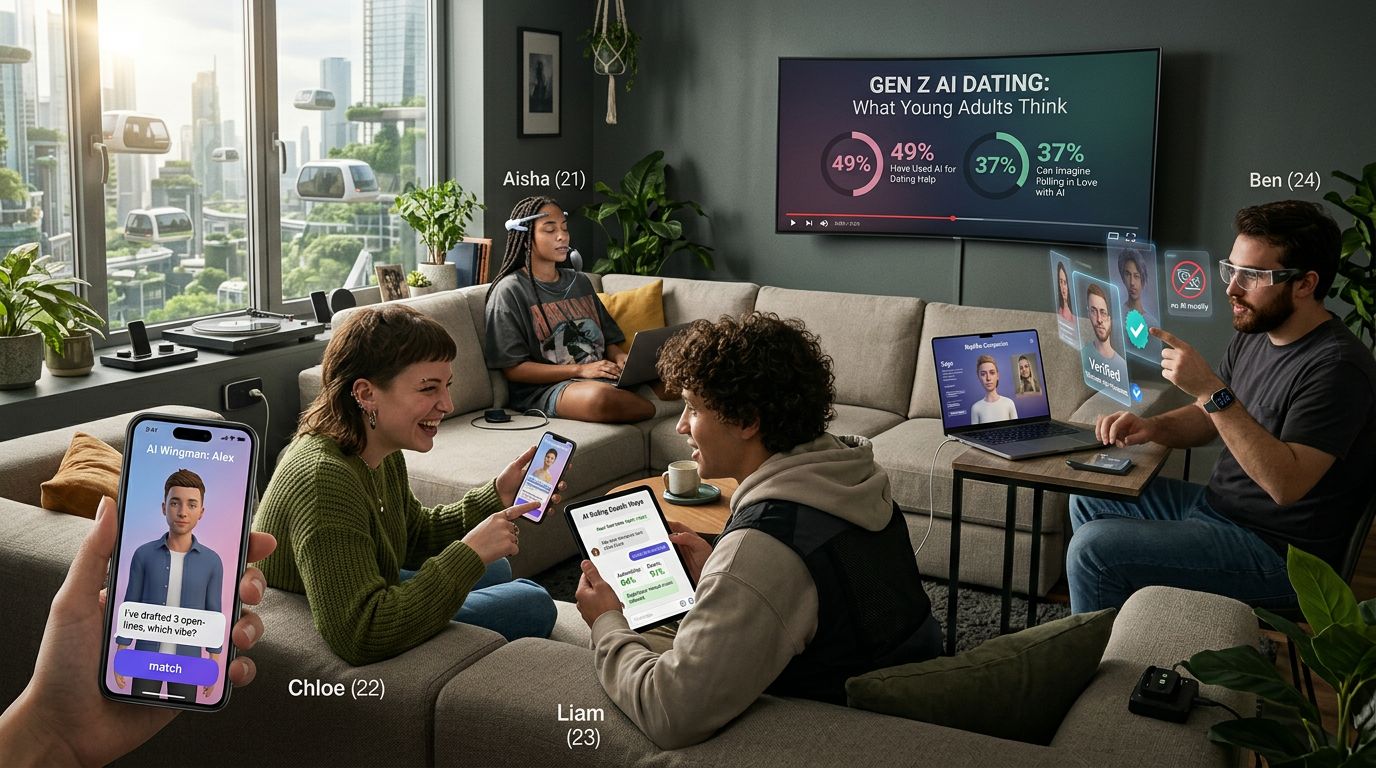
Picture this: your coworker's 23-year-old nephew spends more time chatting with his AI girlfriend than swiping through any dating app. He's not weird about it — he just figures a companion that actually listens beats another ghosted Hinge message. That scenario sounded science-fiction 18 months ago. Now? It's Tuesday.
Gen Z AI dating isn't some niche trend anymore. It's become the conversation in dorm rooms, coffee shops, and yes — family group chats. Roughly a third of Gen Z singles have already talked to an AI romantic companion, and that number keeps climbing. So what's actually going on here, and why does Gen Z AI dating feel so normal to this generation? Are young adults genuinely turning away from human dating? Is this healthy? Or is it just another phase that'll fade by 2027? Let's unpack the data, the psychology, and what it all means for the future of dating.
Gen Z AI Dating: The Numbers Don't Lie
Before we theorize about loneliness or social skills, let's look at the actual research. The stats paint a picture that's both fascinating and, honestly, a little uncomfortable for the dating-app industry.
According to RubyChat's 2026 AI Companion Report, 33% of Gen Z singles have engaged with an AI romantic companion. That's roughly double the rate of older millennials in the same age bracket back in 2021. Among men aged 18–30, the figure climbs to 31%, and even young women are checking in at 23%.
Teen numbers are even wilder. Common Sense Media found in mid-2025 that 72% of US teens had tried an AI companion, with more than half using one regularly. Thirteen percent of them use one daily. These aren't fringe users. They're your classmates, your friends' siblings, maybe your students.
Then there's the spending. Market forecasts peg the AI companion economy at roughly $50 billion in 2026, with the AI girlfriend slice alone worth about $2.3 billion. People aren't just testing this stuff out — they're paying for subscriptions, upgrades, and premium personas. The average user of the leading AI companion app clocks about 93 minutes a day inside the chat. That's longer than most people spend on Instagram.
- 33% of Gen Z singles have chatted with an AI romantic companion
- 72% of US teens have tried an AI companion
- 93 minutes per day — average time spent in AI companion apps
- 220 million cumulative downloads of AI companion apps in 2025
- $50B projected AI companion market in 2026
Why Gen Z Prefers Chatbots to Blind Dates
The "why" matters more than the "how many." And the reasons Gen Z AI dating has caught on aren't what older generations might assume. If you ask a 22-year-old why they'd rather message a chatbot than sit through another awkward first date, you'll hear the same handful of answers: efficiency, emotional safety, and the absence of judgment.
It's not that young people hate human connection — they're starving for it. Surveys consistently rank loneliness as one of the defining problems of this age group. What's changed is their tolerance for the hoops you have to jump through. Dating apps promised connection and delivered burnout. Ghosting, catfishing, endless small talk: after your fifth "hey" message gets left on read, a chatbot that actually responds starts to look appealing.
There's also the control factor — and no, I don't mean that in an icky way. An AI companion won't judge your weird hobby, won't text back passive-aggressively at 2am, won't bring up your last relationship unprompted. It's a zero-pressure environment where young adults can figure out what they like, practice conversation, and experiment with emotional intimacy on their own terms. Think of it like a flight simulator before you actually get in the cockpit.
For neurodivergent young adults, the appeal is even clearer. Social anxiety, sensory overload, the pressure of eye contact — these aren't small things. Several users in Reddit threads and survey comments describe AI companions as their first genuinely comfortable experience with "romantic" interaction. Not because they can't connect with humans, but because they need runway before takeoff.
And let's be honest: there's the novelty factor. Gen Z has never lived in a world without TikTok, without algorithmic recommendation, without AI-generated art. Chatting with a smart bot isn't weird to them — it's just another kind of interface. The stigma gap between older and younger users is enormous. Where millennials worry about what their friends would think, Gen Z shrugs and says, "everyone's doing it."
What the Critics Get Wrong (and Right)
The backlash is predictable. Every article about Gen Z AI dating inevitably quotes some psychologist warning about emotional atrophy, social skill loss, and the slow death of real relationships. Some of those concerns are legitimate. Others are, frankly, out of touch. The honest answer sits somewhere in the middle — and it depends a lot on which users you're actually talking to.
Here's what the critics get right: there's a real risk of substituting. If every lonely night gets spent with an AI instead of reaching out to a friend, that's not great. Psychologists tracking emotional attachment patterns to AI companions have flagged a minority of users who retreat further from offline interaction over time. Those cases deserve attention, not dismissal.
Then there's the privacy angle. A surprising study from Surfshark found that most users don't read — or even notice — the data policies governing their AI companion chats. These are deeply personal conversations. Your fears, your fantasies, your half-formed thoughts about who you are. Handing all that to a third-party company without even glancing at the terms? That's a future data breach waiting to happen.
But here's what the panic-mongers miss: the majority of users treat AI companions the way they'd treat a journal, a meditation app, or a late-night conversation with a supportive friend. It's additive, not replacing. And for some people — the ones who were drowning in social isolation before — it genuinely helped them step back into the world, not further away from it.
Fortune's deep dive on the topic found something similar: even the dating app companies themselves have invested in AI features (Hinge's Convo Starters, Bumble's opening-line coach) because their own users ask for it. The idea that AI and human dating are strictly opposed doesn't match what's actually happening on the ground.
Gen Z AI Dating vs. Traditional Dating: Honest Comparison
If you're still wondering whether the shift is meaningful or just hype, here's how the two worlds stack up side by side:
| Factor | Gen Z AI Dating Apps | Traditional Dating Apps |
|---|---|---|
| Availability | 24/7, instant response | Depends on match activity |
| Emotional safety | Zero judgment, controlled pace | Higher rejection risk |
| Cost | $15–$30/month premium | $15–$60/month premium |
| Privacy data | Often unclear — read the policy | Typically better disclosed |
| Long-term potential | Doesn't replace human relationships | Leads to partnerships, marriage |
| Best use case | Companionship, practice, processing | Seeking a life partner |
| User demographics | Skews 18–28, slightly male | Broad, skews 25–40 |
One thing worth noting: these two categories aren't mutually exclusive in people's lives. The same young adult who chats with their AI companion at midnight might be on Bumble by morning. The AI-vs-dating-apps conversation misses the fact that lots of Gen Z daters use both simultaneously.
How OnlyGFs and Similar Platforms Fit In
Not every AI companion experience is the same, but for plenty of young adults, the Gen Z AI dating world has consolidated around a few platforms that get the vibe right. The ones that have caught on aren't trying to be therapist bots or productivity assistants — they're leaning into personality, aesthetic, and emotional texture.
Take OnlyGFs, for example. The platform focuses on companion-first experiences: you pick a character with their own backstory, their own communication style, and you build an ongoing dynamic with them. It's not "how can I optimize my dating life" — it's "I want someone interesting to talk to who actually pays attention." That's the pitch, and judging by adoption numbers, it's landing.
What's telling is how the platforms that do well with Gen Z prioritize conversational quality over utility. They want the AI to feel like a specific someone, not a helpful assistant with a personality skin. That's why multimodal additions — voice, video, AR — keep getting rolled out. Text alone can only carry so much of the illusion. Young users expect the experience to feel embodied, not flat.
This is also where the market forecasts get interesting. If $50 billion sounds like a lot, remember the counterfactual: Gen Z is already used to paying for digital relationships (gaming skins, creator subscriptions, Discord perks). An AI companion with memory, voice, and a distinct personality is, in some ways, the natural evolution of those habits.
The Relationship Skills Debate
One of the more thoughtful corners of the Gen Z AI dating conversation asks: can you actually learn anything from an AI companion that transfers to real relationships?
The answer isn't straightforward. On paper, an AI companion gives you a space to practice articulating your feelings, setting boundaries, and navigating emotional conversations without stakes. That should build transferable skills. Some therapists even endorse it as a low-risk sandbox for patients working through social anxiety.
In practice, though, the skills that matter most in human relationships — reading body language, sitting with awkward silences, navigating conflict that can't be paused — aren't really part of the AI companion loop. You don't get that training inside a chat window. So the benefit is real but partial. It's like learning to swim in a warm, still pool; the ocean is a different story.
Young adults who use AI companions and stay socially active tend to describe the experience positively: it helps them decompress, practice, and feel less alone between real interactions. Those who use it in place of social contact often report the opposite. The pattern's pretty clear — for most people, Gen Z AI dating is a tool, and like any tool, the user determines the outcome.
What This Means for the Next Five Years
If the last 18 months are any indicator, Gen Z AI dating will only become more integrated into mainstream youth culture. The technology's getting better — more natural voices, better memory, more realistic avatars — and the stigma's getting quieter. Every quarter brings a new wave of apps, new use cases, and (slowly) new norms. Gen Z AI dating today looks nothing like what it did in 2023, and the 2028 version will probably feel just as different.
What's less clear is how this generation's ideas about romance will evolve. They've grown up with algorithmic matching, disposable swipes, and now persistent AI companions. Their definition of "real" relationships has always been broader than what their parents imagined. AI companions are expanding that definition further, and whether that's healthy, inevitable, or both is a question that won't be settled by op-eds alone.
That doesn't doom human connection. But it does mean the institutions and industries built around traditional dating — the apps, the matchmakers, the relationship advice columnists — will need to adapt or get left behind. Young adults aren't waiting around for permission. They're building their own frameworks for intimacy, one late-night chat at a time — and Gen Z AI dating is just the opening act.
Sources
- RubyChat — The Data Behind How AI Girlfriends Are Changing Modern Relationships (2026)
- Prinsessa StaySocial — AI Companion & Human AI Market Forecast 2026
- Common Sense Media — Talk, Trust, and Tradeoffs: How and Why Teens Use AI Companions (2025)
- Mashable — Gen Z Daters Want Deeper Connections, but Some Use AI to Bridge the Communication Gap
- Surfshark — AI Companions and Privacy Study
Frequently Asked Questions







 My Private Content