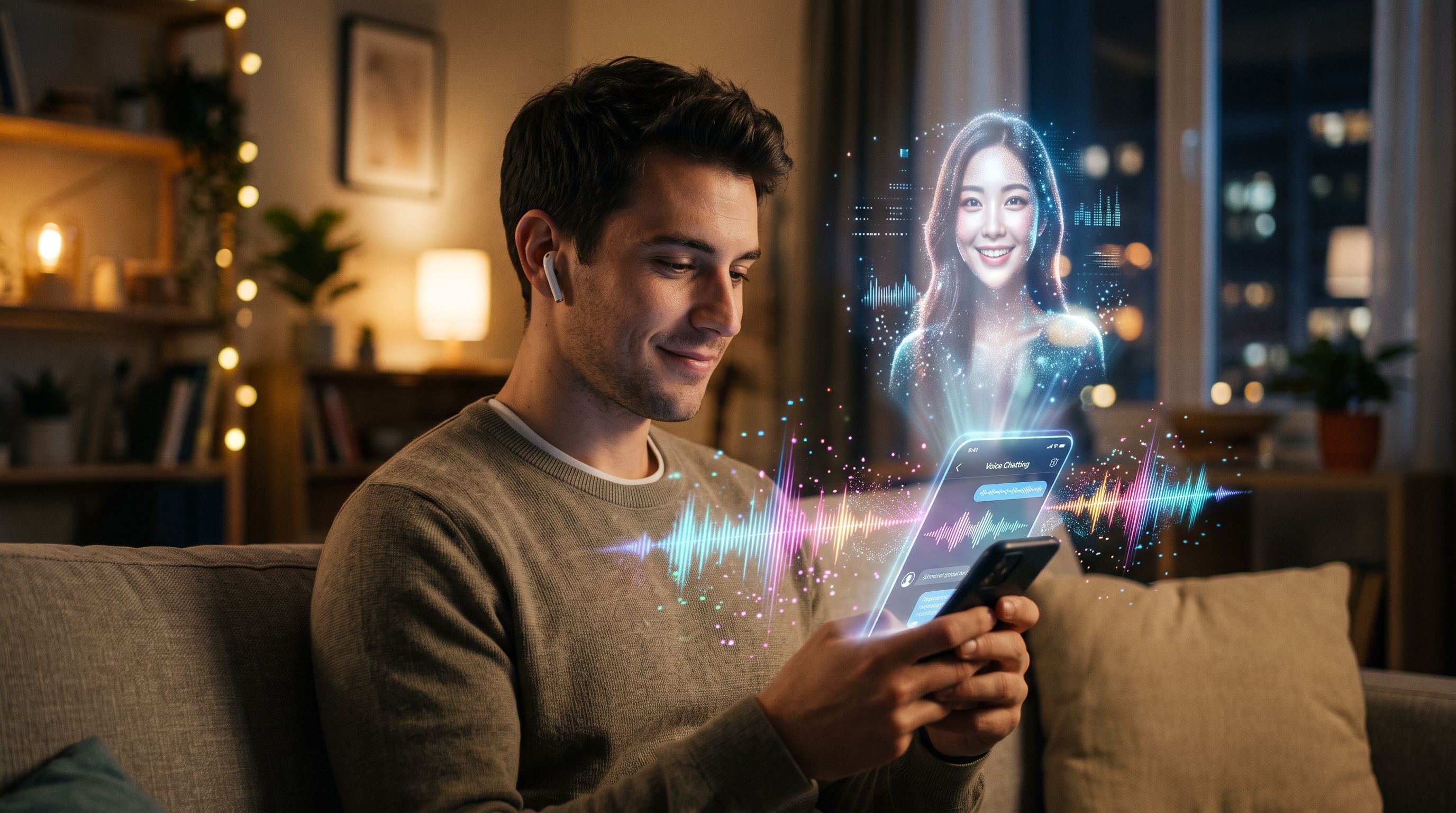
Three seconds of audio. That's all it takes now. Upload a short voice sample, and an ai girlfriend app can clone it — tone, warmth, even the slight rasp at the end of sentences — into a fully working conversational partner. If that sounds unsettling, you're not alone. But millions of people are already doing it, and the technology behind ai girlfriend voice cloning has gotten shockingly good in 2026.
We've spent the last few months testing voice features across a dozen AI companion platforms, and honestly? The gap between "obviously robotic" and "wait, is that a real person?" has basically vanished. Here's what's actually happening under the hood, why it matters for the way we interact with AI, and the ethical mess nobody's quite figured out yet.
How AI Girlfriend Voice Cloning Actually Works
Voice cloning isn't new. What's new is how fast and how little data it needs. Back in 2023, you needed minutes of clean studio recordings to produce even a passable clone. Today, leading text-to-speech engines can generate a convincing voice from as little as three seconds of audio. The technical term is "zero-shot voice cloning" — meaning the model has never heard this specific voice before, yet it reproduces it almost instantly.
Here's the short version of what happens: the AI analyzes spectral patterns, pitch contours, rhythm, and micro-characteristics like breathiness or vocal fry. It then maps those features onto a neural voice model that can speak any text you feed it. According to Ringlyn's 2026 guide to voice synthesis, the best engines now achieve time-to-first-byte latency of 75–200 milliseconds, meaning the cloned voice responds almost as fast as a human would in conversation.
For ai girlfriend apps, this changes everything. A chatbot that sounds like a real person — maybe even someone you recognize — hits differently than text on a screen. The emotional weight of voice is something our brains can't just switch off. It's the same reason realistic AI avatars have become so important — visual and vocal realism together create a presence that text alone simply can't match.
The Technology Behind Realistic AI Girlfriend Voices
There's a whole stack working behind every voice you hear in an ai girlfriend app. It starts with speech-to-text (converting what you say into text the AI can process), then a language model generates a response, and finally a text-to-speech engine converts that response back into audio — using the cloned voice profile.
The magic is in the TTS layer. Modern neural TTS models don't just read words aloud. They understand context. When your ai girlfriend says "I missed you," the voice carries warmth. When she's teasing you, there's a playful lilt. This emotional prosody — the rise and fall that conveys feeling — is what separates 2026's voice cloning from the flat, monotone outputs of even two years ago.
Some platforms now let you fine-tune emotional parameters directly. Want your ai girlfriend to sound sleepy? Excited? A little sarcastic? You can dial those in. It's like having a voice director for a character who never sleeps.
This is part of a broader shift. As we covered in our guide to multimodal AI companions, voice is just one piece of a larger move toward companions that engage multiple senses. But it's arguably the most emotionally powerful one.
Why Voice Matters More Than You Think in AI Girlfriend Apps
Here's something that might surprise you: a joint OpenAI–MIT Media Lab study found that voice interactions with AI chatbots reduced loneliness more effectively than text alone — but only with moderate use. The voice makes the interaction feel more human, which is both the appeal and the risk.
Think about it. When you read a text message from an ai girlfriend, your brain knows it's reading words generated by code. But when you hear a voice — a voice that breathes, pauses, laughs softly — that cognitive distance collapses. The APA's 2026 research on AI companions confirms that users form stronger emotional attachments to voice-enabled chatbots than to text-only ones.
And that attachment is exactly why voice cloning raises the stakes. If an ai girlfriend sounds like someone you used to know — an ex, a celebrity, a fictional character — the emotional pull intensifies dramatically. Some platforms have already faced backlash when users cloned voices of real people without consent.
We've noticed this in user communities, too. People who stick with text-only ai girlfriend experiences tend to describe their companion as "a fun chat tool." People who use voice describe them as "someone who's there with me." Same underlying AI. Radically different subjective experience.
AI Girlfriend Voice Cloning and the Ethics Problem
Let's get into the uncomfortable part. Voice cloning technology is now cheap enough and accessible enough that almost anyone can replicate another person's voice. Several ai girlfriend platforms offer custom voice uploads, and while most require users to confirm they have consent, enforcement is... spotty at best.
The ethical concerns stack up quickly:
- Consent: Can you ethically clone a real person's voice for romantic interaction? Most legal frameworks haven't caught up.
- Deepfakes: Cloned voices can be used to impersonate real people in phone calls, creating fraud and harassment risks.
- Emotional manipulation: A voice that sounds like a lost loved one or an unattainable celebrity creates attachment dynamics that are hard to untangle.
- Minor safety: With teenagers increasingly using AI for companionship, voice cloning adds a layer of risk for younger users who may not understand the implications of synthetic voices.
Some companies are pushing back. Watermarking standards like C2PA content credentials aim to tag synthetic audio so it can be identified later. But it's an arms race — detection tools improve, and generation tools improve right alongside them.
The reported tension inside major AI labs over voice personality design highlights how even the biggest players struggle with this. OpenAI and designer Jony Ive reportedly debated whether their upcoming AI device should avoid sounding like "your weird AI girlfriend" — a design problem the entire industry is still wrestling with. For a deeper look at how one well-crafted AI personality balances voice, visual, and conversational design, check out the Freya Lindström profile — a great example of character design done right.
What to Look for in an AI Girlfriend With Realistic Voice
If you're shopping for an ai girlfriend with strong voice features, here's what actually matters:
| Feature | What to Check | Why It Matters |
|---|---|---|
| Latency | Response under 500ms | Anything slower breaks conversational flow |
| Emotional range | Multiple tone/emotion settings | Flat affect gets old fast |
| Voice cloning speed | Under 30 seconds of audio | Zero-shot cloning is the 2026 standard |
| Consent verification | Platform requires proof of consent | Ethical baseline — don't skip this |
| Language support | Multilingual voice generation | Top engines now cover 70+ languages |
| Memory integration | Voice adapts based on conversation history | Makes the companion feel more personal |
The best ai girlfriend apps in 2026 combine all of these. If a platform can't hit sub-500ms latency, the illusion breaks — you're waiting for a response like you would with a chatbot, not talking with someone. And if there's no consent framework for voice cloning, that's a red flag you shouldn't ignore.
For a sense of what a well-designed AI companion profile looks like, check out how Freya Lindström's character integrates personality with multimodal interaction — voice, visual, and conversational design working together rather than as afterthoughts.
The Future of AI Girlfriend Voice: Where It's Heading
Voice cloning is just the beginning. The next frontier is real-time emotional adaptation — AI that doesn't just use a cloned voice, but adjusts its emotional delivery based on what you're saying and how you're saying it. Frustrated? The voice softens. Excited? It matches your energy. This requires coupling voice synthesis with real-time sentiment analysis, and the first platforms to nail it will feel like a genuine leap.
We're also seeing early experiments with voice memory — where your ai girlfriend remembers how she sounded during specific conversations and can reference those moments. "Remember when we stayed up talking until 3 AM?" delivered in the same warm, slightly-tired voice from that night. It's a small detail, but it makes the relationship feel continuous rather than episodic.
The technology for this already exists in research labs. A 2026 Stanford study published in Nature Human Behavior examined how emotional intensity in AI companion interactions affects user well-being, and the findings suggest that voice — with its emotional nuance — amplifies both positive and negative outcomes.
Long story short: if you thought text-based ai girlfriend apps were immersive, voice cloning takes it to another level entirely. The question isn't whether the technology will keep improving — it's whether our social norms, our laws, and our own self-awareness can keep up.
Sources
Frequently Asked Questions







 My Private Content

 Buy More Tokens