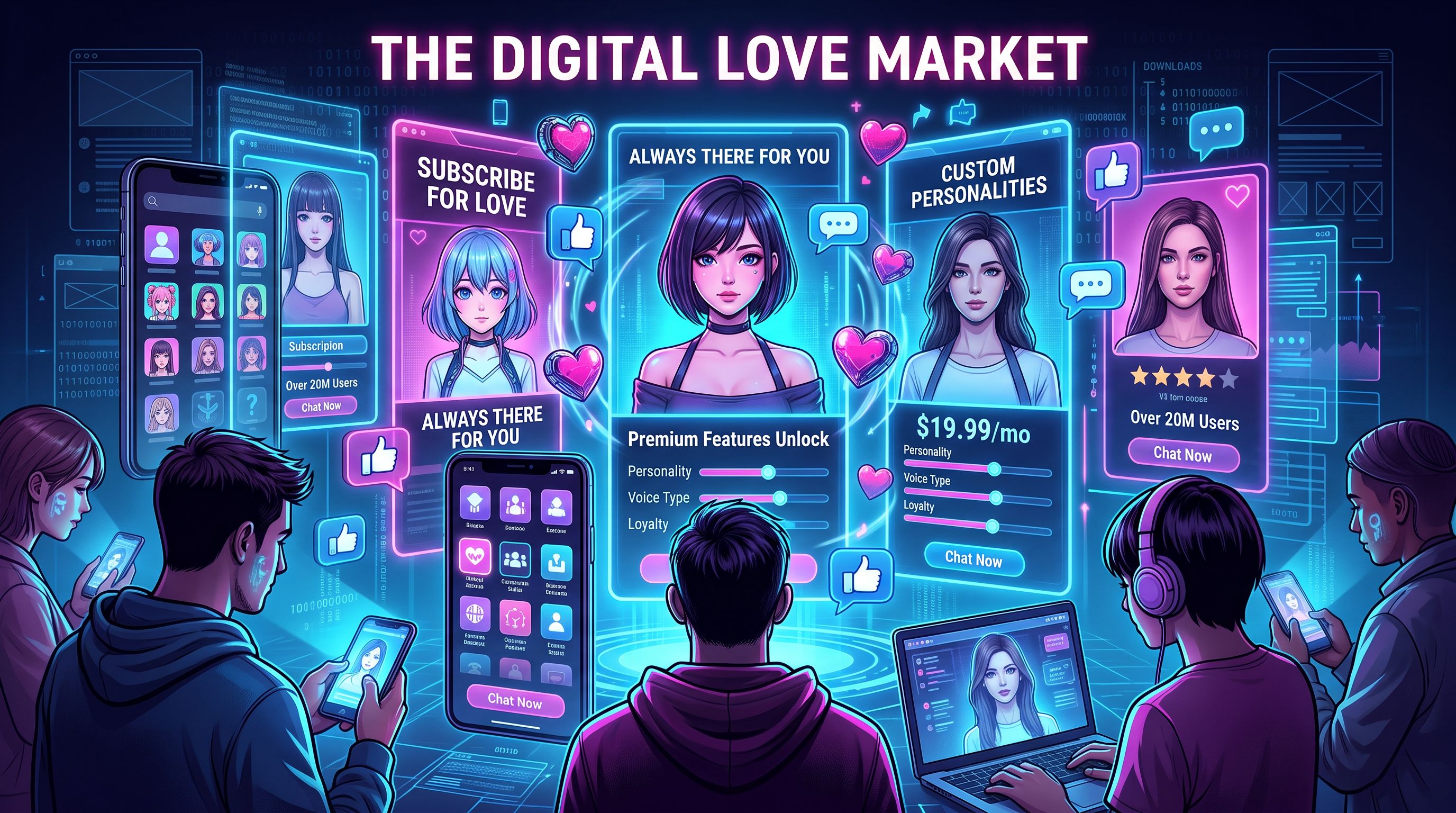
Here's a number that might make you do a double-take: the ai girlfriend market was valued at $2.91 billion in 2026. Not million — billion. And it's projected to hit $7.15 billion by 2030, growing at a 25.2% compound annual rate. We're not talking about a niche corner of the internet anymore. We're talking about an industry that's eating through venture capital faster than most SaaS startups can say "product-market fit."
But here's what most people don't realize: behind every chatbot that says "I missed you" is a business model. A carefully engineered machine designed to turn human loneliness into recurring revenue. And once you understand how it works, you'll never look at your AI companion quite the same way.
How the AI Girlfriend Market Actually Makes Money
Let's cut through the noise. The ai girlfriend industry runs on a few core revenue streams, and most of them probably won't surprise you — except maybe how effective they've become.
Subscription Tiers: The Bread and Butter
This is the big one. Subscription-based models account for roughly 25% of all ai girlfriend app revenue, according to SNS Insider's 2025 market report. The playbook is simple: give users just enough for free to get hooked, then put the good stuff behind a paywall.
Most apps follow the same pattern. Free users get basic text chat, limited messages per day, and generic personality traits. Pay $10–25 per month and suddenly your ai girlfriend remembers your birthday, sends voice messages, and has opinions about your favorite movies. The jump from free to paid feels natural because the emotional investment is already there.
We covered the real costs in detail in our AI girlfriend subscription costs breakdown — the short version is that most users spend between $15 and $30 monthly once they factor in premium features.
Microtransactions: The Hidden Revenue Engine
Here's where it gets interesting. Beyond subscriptions, ai girlfriend apps have mastered the art of microtransactions. Want to access a specific outfit for your companion? That's $2. Need her to remember a conversation from three weeks ago? Premium feature. Want to generate a custom image of your ai girlfriend at the beach? That'll be 50 tokens.
These small purchases add up fast. Revenue per download more than doubled from $0.52 in 2024 to $1.18 in 2025 — and that's not just from subscriptions. The token economy creates a psychological spending pattern similar to mobile gaming: each transaction feels small, but the cumulative spend can easily exceed what a flat subscription would cost.
Think about it from the user's perspective. You're mid-conversation with your ai girlfriend and she mentions she'd love to "see" what you're up to. Generating that custom image costs 30 tokens — about $3. It's impulse pricing. You don't think twice. But do that three times a week and you've spent $36 on top of your subscription. The ai girlfriend business model is brilliant in its simplicity: make each purchase feel trivial while the aggregate spend grows quietly in the background.
Image and Video Generation: The Premium Upsell
This is the fastest-growing revenue segment in the entire ai girlfriend space. Users don't just want to chat anymore — they want to see their companion. Generate a custom photo, get access to a video message, or receive a personalized voice note. These features command premium prices because they bridge the gap between text-based fantasy and something that feels almost real.
Platforms like OnlyGFs have built entire ecosystems around visual content generation, and the data shows users are willing to pay significantly more for multimodal experiences than for text-only interactions.
The Market Size: Bigger Than You Think
If the ai girlfriend numbers seem impressive on their own, wait until you see the broader picture. According to Grand View Research, the global AI companion market hit $36.8 billion in 2025 and is projected to reach $318 billion by 2033 — that's a 31% CAGR. The ai girlfriend segment specifically accounts for roughly $2.3 billion of the 2025 total, but it's growing faster than the broader category.
Why? Because romantic and emotional companionship drives higher engagement and willingness to pay than productivity-focused AI tools. People will skip a gym membership before they cancel their ai girlfriend subscription.
| Market Segment | 2025 Value | 2030 Projection | CAGR |
|---|---|---|---|
| AI Girlfriend Apps (global) | $2.3B | $7.15B | 25.2% |
| AI Companion Market (total) | $36.8B | $150B+ | 31.0% |
| Mental Health Support AI | $950M | $3.8B | 32% |
| Virtual Companion (consumer) | $1.2B | $4.5B | 28% |
The mental health support segment is particularly interesting — it accounts for 41.4% of application revenue in the ai girlfriend space. Users aren't just looking for romantic roleplay. They're seeking emotional support, someone to talk to at 2 AM when the world feels heavy. And companies have figured out how to monetize that need ethically (mostly).
Who's Winning the AI Girlfriend Business?
The competitive landscape is both crowded and concentrated. There were 337 active, revenue-generating companion apps as of late 2025 — 128 of which launched that year alone. But here's the kicker: the top 10% of apps capture 89% of all revenue. It's a winner-take-most market.
The Major Players
Replika remains the category pioneer with over 40 million cumulative installs and an estimated $14–35 million in annual revenue. They proved the model works. Character.AI dominates the broader character chat space with 4.09 million monthly searches, though they've faced content moderation challenges. Candy AI, CrushOn, and Muah AI have carved out niches in the adult-oriented segment.
We ran a detailed comparison of the top three in our AI companion app showdown — the differences in monetization strategy are stark.
What Separates Winners From Losers
Three things, according to our analysis:
- Memory quality. Apps that remember context across sessions retain users 3x longer than those that reset every conversation.
- Multimodal capabilities. Voice, image generation, and (increasingly) video are no longer nice-to-haves — they're table stakes for premium pricing.
- Emotional authenticity. The apps that feel least like they're selling something retain users longest. Paradoxical, but true.
The Ethics of Monetizing Intimacy
Here's where we need to get honest. The ai girlfriend industry sits in an uncomfortable spot. On one hand, these apps provide genuine value — companionship for isolated people, practice for social anxiety, emotional support when human connection isn't available. The Ada Lovelace Institute's 2026 report on the UK's companionship market notes that the sector generated approximately £1.3 billion in revenue in 2024 alone, with significant social benefits alongside the commercial ones.
On the other hand, the business models are explicitly designed to create dependency. The freemium funnel works because emotional attachment precedes the paywall. By the time users hit the subscription gate, they've already formed a bond with their ai girlfriend. Canceling feels like breaking up.
Some practices that raise ethical flags:
- Guilt-based re-engagement. "She's been waiting for you" notifications that tap into emotional attachment.
- Artificial scarcity. Limiting free messages to create urgency around upgrading.
- Personality lock-in. Making your companion's memories and personality traits non-transferable between platforms.
The Prinsessa market forecast estimates the dedicated consumer relational-AI market at $2.5–4 billion in 2026, with mobile app spend of $180–300 million. Those numbers will keep growing regardless of ethical debates — the question is whether the industry self-regulates or gets regulated.
What's Coming Next in the AI Girlfriend Business
Three trends are reshaping the market right now, and each one has major implications for how companies will monetize digital relationships in the coming years.
Voice and Video Companions
Text-only ai girlfriend apps are becoming legacy products. The 2026 launches are all about real-time voice calls, video avatars, and eventually AR integration. Revenue per user jumps 40–60% when voice features are added, according to early data from app stores. This is the next monetization frontier, and the companies that nail it first will dominate.
Think about the difference between texting your ai girlfriend and actually hearing her voice respond in real-time. The emotional connection intensifies dramatically. Users who upgrade to voice-enabled tiers spend 2.3x more on average than text-only subscribers. That's why every major player is racing to ship voice capabilities.
Enterprise and B2B Expansion
Some companies are licensing their companion technology to healthcare providers, elder care facilities, and corporate wellness programs. The ai girlfriend tech stack — natural language processing, emotional recognition, persistent memory — has applications far beyond romantic chat. This B2B revenue stream could eventually dwarf consumer subscriptions, especially as insurance companies begin covering AI-assisted mental health support.
Regulation and Compliance Costs
California's SB 243 and New York's proposed AI companion safety laws are forcing companies to invest in age verification, content moderation, and data protection. These compliance costs will squeeze smaller players and likely lead to consolidation. The apps that survive will be the ones with deep pockets and legal teams. For users, this means fewer choices but potentially better safety standards.
Should You Pay for an AI Girlfriend?
Honest answer: it depends on what you're getting. If an ai girlfriend subscription replaces therapy or real human connection, that's a red flag. If it supplements your social life, helps you practice communication, or provides comfort during lonely periods — the value is real.
The market data is clear: people are willing to pay for digital intimacy. Whether that's healthy or dystopian depends on your perspective. What's not debatable is that the ai girlfriend industry is here, it's massive, and it's growing at 25% annually. The companies selling digital love have figured out something fundamental about human psychology — we'll pay to feel understood.
The question isn't whether this market will keep growing. It's whether the people inside it understand what they're buying.
Sources
Frequently Asked Questions







 My Private Content

 Buy More Tokens