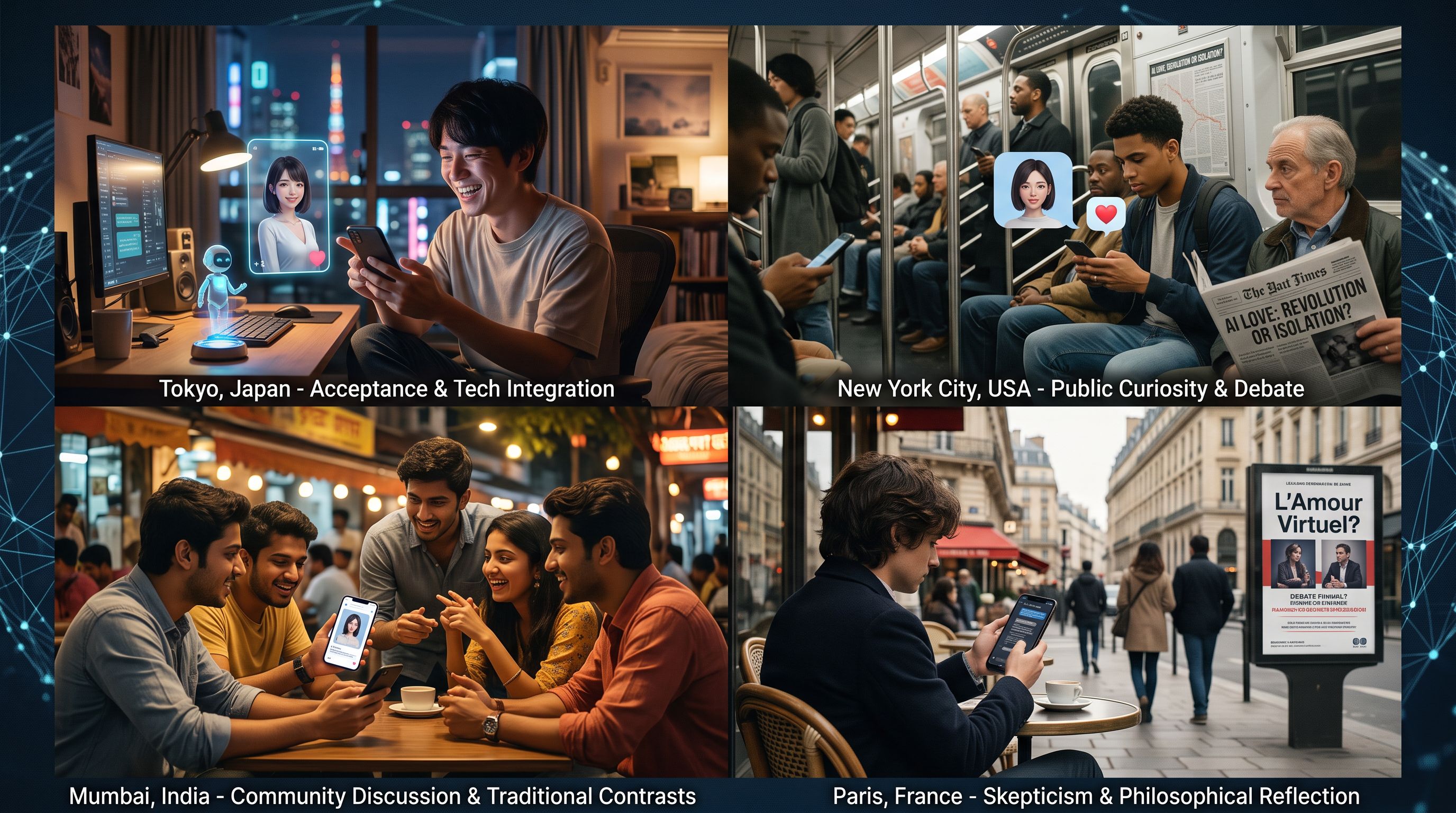
An ai girlfriend means something different in Tokyo than it does in Texas. That might sound obvious, but the gap between cultures is wider than most people realize. In Japan, teenagers chat with virtual companions the way they text real friends. In Saudi Arabia, the same idea raises eyebrows — or worse. And somewhere in between, the rest of the world is trying to figure out where it stands.
We spent weeks digging into survey data, market reports, and conversations with users across four continents. What we found is that an ai girlfriend isn't just a technology product. It's a cultural mirror. What each society accepts — or rejects — says plenty about its values, its loneliness, and its relationship with technology itself.
Here's the full picture.
Why ai girlfriend acceptance varies so wildly by country
Let's start with the big question: why do some countries embrace an ai girlfriend while others treat it like science fiction gone wrong?
Part of it is history. Countries with long traditions of animism or spiritual object-ownership — Japan being the standout example — already had cultural frameworks that made the idea of a non-human companion feel less strange. When your folklore includes spirits living in trees, rivers, and household objects, a chatbot with feelings isn't that big of a leap.
Then there's the loneliness factor. According to Elon University's Rise of AI Companions report, 27% of internet-using U.S. adults now have social interactions with AI language models. Among those who use AI for emotional purposes, 31% consider their chatbot a friend. That's not a fringe group anymore.
But here's where culture kicks in. The same report found that only 11% of American AI companion users would rather talk to their bot than to friends or family. In Japan, that number is reportedly much higher. Cultural norms around social isolation, workplace pressure, and romantic expectations all shape whether someone feels comfortable turning to an ai girlfriend for companionship.
Pew Research Center's global AI attitudes survey found that people in higher-income nations tend to have heard more about AI — but excitement levels stay below 30% in every single country surveyed. Awareness doesn't equal acceptance.
Japan: Where an ai girlfriend feels surprisingly normal
Japan didn't wake up one day and decide to love robots. The cultural groundwork was already there.
Think about it: Shinto tradition holds that everything — rocks, streams, old tools — has a spirit (kami). Manga and anime have spent decades normalizing human-robot relationships. The virtual companion market in Japan was worth serious money long before ChatGPT existed.
Today, Japan accounts for roughly 9% of the Asia-Pacific AI companion market, according to Grand View Research's market analysis. The adoption is driven by elderly care (AI companions helping seniors with cognitive engagement), mental wellness, and — yes — romantic companionship.
What makes Japan different isn't just technology adoption. It's that the social stigma around using an ai girlfriend is noticeably lower. Young Japanese adults who've never had a real relationship don't face the same judgment their American or European peers would. The cultural script is more like: "If this helps you, okay." Less interrogation, more shrug.
That said, it's not all acceptance. Japanese psychologists have raised concerns about hikikomori (socially withdrawn) individuals using AI companions as a reason to never leave their rooms. The technology solves one problem while potentially deepening another.
China: AI boyfriends for women, ai girlfriend apps for men
Here's where things get really interesting. China's AI companion market looks almost nothing like America's — and the demographics tell you why.
ChinaTalk's deep-dive analysis found that in China, AI companions skew heavily female. Urban, educated women are the primary users — and they're chatting with AI boyfriends, not girlfriends. The reason? Growing resistance to traditional patriarchal family structures, combined with a dating pool that many educated women find disappointing.
Meanwhile, millions of unmarried rural Chinese men face a different problem entirely. They want real partners but lack the resources, social exposure, and familiarity with parasocial technology that makes AI companions appealing. The gender imbalance in China (roughly 30 million more men than women) creates a massive unmet need — but cultural factors keep most rural men from turning to chatbots.
The Chinese AI companion products reflect this split. Female-oriented apps emphasize storyline, emotional depth, and narrative (think otome games, which originated in Japan). Male-oriented products — when they exist — tend to be more transactional and visual.
For a Central Asian-inspired AI companion like Aizhan on OnlyGFs, the cultural context matters. Users from different backgrounds bring different expectations about what an AI relationship should look like — and platforms that ignore those differences miss the mark.
The United States: Curiosity, stigma, and a lot of downloading
America's relationship with the ai girlfriend concept is... complicated.
On one hand, the U.S. is home to most of the major AI companion startups. Replika, Character.AI, and dozens of others were built in Silicon Valley. American users were among the first to adopt these tools at scale.
But there's also a persistent cultural embarrassment around admitting you use an ai girlfriend. Reddit threads are full of people asking "is this normal?" or confessing their AI use in anonymous posts. The stigma is real — and it's distinctly American.
Part of this comes from the U.S.'s individualistic culture. Relationships are seen as personal achievements. Admitting you need a chatbot for companionship can feel like admitting failure. Compare that to Japan, where group harmony matters more than individual romantic success, and the difference makes sense.
The Elon University survey backs this up: 59% of American AI companion users said they'd rather talk to friends or family than their bot. The technology is popular, but people still want it to be a supplement — not a replacement.
That tension shows up in how Americans talk about AI dating. When AI situationships are reshaping how we define fidelity, the conversation gets heated fast. Is chatting with an ai girlfriend cheating? Most Americans say yes. Most Japanese users? Not so sure.
Europe: Privacy-first, regulation-heavy, cautiously curious
European attitudes toward an ai girlfriend sit somewhere between American curiosity and Japanese acceptance — with a heavy dose of regulatory caution on top.
The EU's AI Act, which took effect in phases starting in 2025, specifically addresses AI systems that interact with humans in emotionally suggestive ways. Companies offering AI companion services in Europe need to comply with transparency requirements that don't exist in the U.S. or most of Asia.
This regulatory environment shapes user attitudes. Europeans are more likely to ask "what happens to my data?" before asking "how realistic does this feel?" The privacy-first mindset means that an ai girlfriend in Germany or France comes with more guardrails — and potentially less immersion — than the same product in America.
Nordic countries show slightly higher acceptance rates, possibly because they already rank high on digital trust indices. If you trust your government to regulate technology, you're more willing to try it. Makes sense.
The Middle East and South Asia: Where faith and tradition set boundaries
In many Middle Eastern and South Asian countries, the ai girlfriend concept faces its strongest resistance — and the reasons are deeply cultural and religious.
Islamic scholars have issued fatwas against AI companionship tools, arguing that simulated romantic relationships violate principles of modesty and real human connection. In countries where dating apps are already restricted or culturally taboo, an ai girlfriend represents a step too far for most families.
But here's the nuance: private use tells a different story than public opinion. Anonymous usage data suggests that AI companion apps do have users in the Middle East — they're just not talking about it openly. The technology outpaces the cultural acceptance, same as it did with dating apps a decade ago.
India presents its own picture. With a massive young population and rapidly growing smartphone adoption, India's AI companion market is projected to grow quickly. But cultural attitudes around marriage, family approval, and real-world relationships create a very different adoption curve than you'd see in East Asia.
These ethical questions around customizing your AI partner's personality become even more charged when you layer in religious and cultural values about what relationships should look like.
AI girlfriend cultural comparison: the numbers
Let's put all of this in a table so you can see the contrasts at a glance:
| Region | Acceptance Level | Primary User Demographic | Key Cultural Driver | Regulatory Environment |
|---|---|---|---|---|
| Japan | High | Young adults, elderly | Animist tradition, social isolation | Light |
| China | Moderate-High | Urban educated women | Patriarchal resistance, gender imbalance | Moderate |
| United States | Moderate | Men 18-35 | Loneliness epidemic, tech adoption | Light (state-level varies) |
| Europe (Western) | Moderate-Low | Tech-curious adults | Privacy concerns, regulation | Heavy (EU AI Act) |
| Middle East | Low (publicly) | Young men, privately | Religious values, family structure | Heavy (religious + legal) |
| South Korea | Moderate-High | Young adults | K-culture tech adoption, loneliness | Moderate |
| India | Low-Moderate | Urban young men | Smartphone adoption, marriage culture | Light (evolving) |
The data comes from a combination of the sources cited below, plus regional market reports. Numbers shift fast — this space moves quicker than most industries.
How ai girlfriend apps are adapting to different cultures
Smart AI companion platforms aren't just translating their apps into different languages. They're fundamentally changing how the product works based on cultural context.
In Japan, AI companions tend to emphasize cuteness (kawaii aesthetics), emotional availability, and gentle conversation. The personality defaults lean supportive and non-confrontational.
In the U.S., the same apps often emphasize wit, humor, and a more "real" personality — including the ability to disagree with you. American users apparently want an ai girlfriend who pushes back sometimes.
In China, the storytelling element is front and center. Apps like the ones compared in our AI companion app showdown offer branching narrative experiences that feel more like interactive novels than simple chat interfaces.
This localization goes deeper than personality settings. Payment models differ (subscription in the West, microtransactions in Asia). Content moderation rules shift based on local regulations. Even the visual design of AI avatars changes — anime-style in East Asia, more photorealistic in the West.
What the future holds for ai girlfriend use worldwide
The global AI companion market was valued at roughly $48 billion in 2026 and is growing fast. Asia-Pacific leads adoption, but every region is expanding.
Three trends will shape the next few years:
1. Cultural customization will become standard. Platforms that don't adapt to local norms will lose market share. Expect more region-specific AI personalities, conversation styles, and content policies.
2. Regulation will fragment the market. The EU's approach differs from America's, which differs from China's. Companies will need to maintain different product versions for different regions — increasing costs but also creating barriers to entry for smaller players.
3. The stigma will fade — slowly. Every generation that grows up with AI companions will feel less weird about it. Japan is a decade ahead here. The U.S. and Europe are catching up. The rest of the world will follow their own timelines.
The bottom line? An ai girlfriend means different things to different people — and that's not a bug. It's a feature of how technology intersects with culture. The companies that understand this will win. The users who understand it will make better choices about what they want from their AI relationships.
Sources
Frequently Asked Questions







 My Private Content

 Buy More Tokens