
You've probably noticed something weird when scrolling through ai companion apps. The faces staring back at you don't look like they came from a clip-art library anymore. They look real — pores, stray eyelashes, that one freckle just off-center on a cheekbone. So what changed? A lot, actually. AI companion image generation has quietly become one of the most technically interesting corners of the generative AI space, and most people scrolling through their chat feed at 2 AM have no idea what's actually making those pixels work.
We've spent the last few months digging into how this stuff actually works under the hood — not the marketing fluff, but the real technology. Here's what we found.
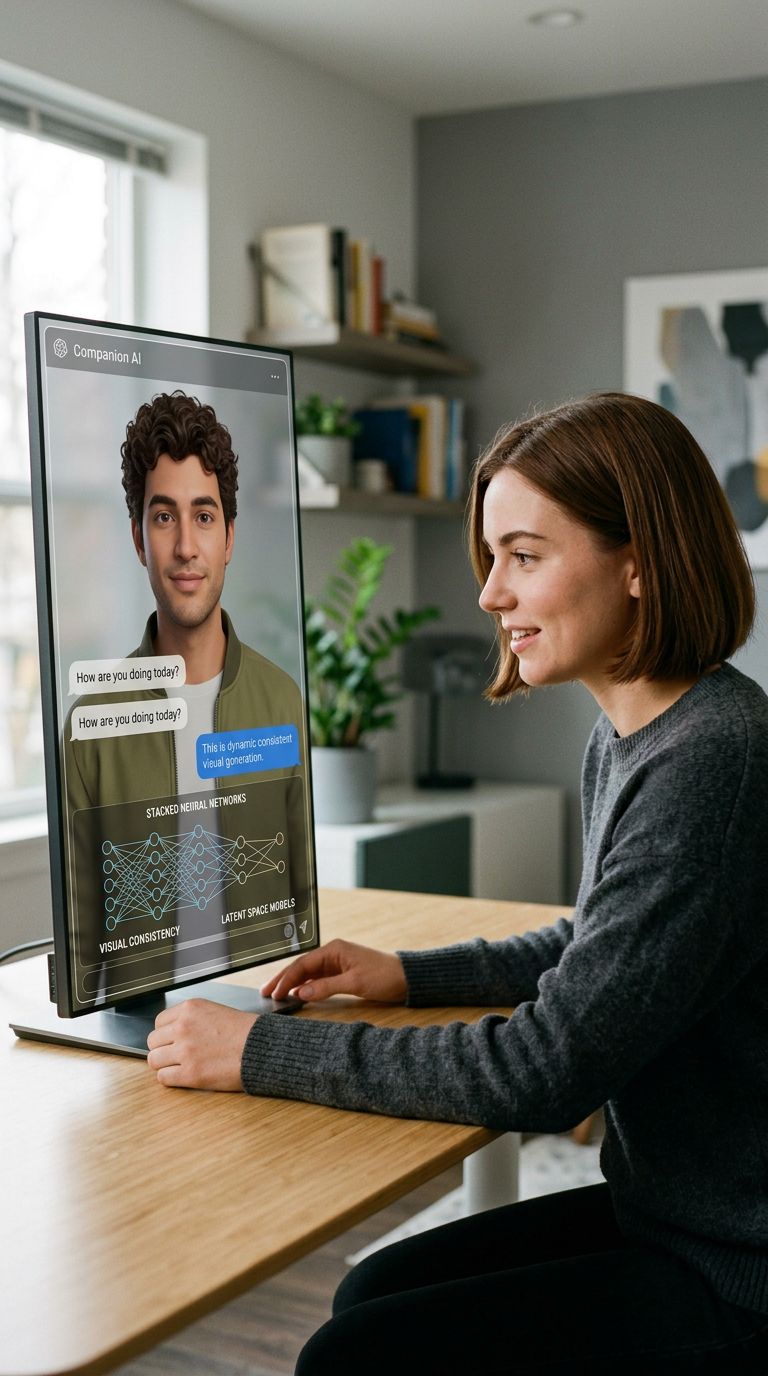
How AI Companion Image Generation Actually Works
At its core, every ai companion photo you see on a dating or companion platform comes from a model that learned what human faces look like by studying millions of real photographs. The models don't understand faces the way you or I do — they've learned statistical patterns. Which pixels tend to cluster around an eye socket. How light bounces off skin at different angles. The subtle gradient shifts that separate warm skin tones from flat, lifeless ones.
The two dominant architectures doing the heavy lifting right now are GANs (Generative Adversarial Networks) and diffusion models. Here's the difference in plain terms:
- GANs pit two neural networks against each other. One generates fake images, the other tries to spot the fakes. They compete relentlessly until the generator produces images so convincing the discriminator can't tell the difference. Think of it like an art forger and a forensic expert locked in a training rivalry for months.
- Diffusion models take a different approach. They start with pure static (random noise) and gradually denoise it step by step until a clear image emerges. It's like sculpting — you start with a block of marble and chip away until something recognizable appears. This is what powers Stable Diffusion and most newer ai companion avatar systems.
Most platforms in 2026 have moved toward diffusion-based pipelines. They're more stable, produce fewer uncanny artifacts, and respond better to fine-grained text prompts. But GANs haven't disappeared — many ai companion apps still use GAN-powered upscalers as the final polish pass, taking a diffusion-generated face and sharpening it into something almost indistinguishable from a photograph.
The Tech Stack Behind AI Companion Realistic Photos
Let's get into the weeds for a second, because the architecture behind a convincing ai companion avatar is genuinely fascinating. It's not one model doing all the work — it's a pipeline of interconnected systems, each handling a specific piece of the puzzle.
Step 1: Text-to-Image Foundation
It starts with a text prompt. Someone (or an automated system) describes the character — "25-year-old woman, auburn hair, warm brown eyes, wearing a gray hoodie, soft studio lighting." The text encoder converts this into a mathematical representation, and the diffusion model uses it as a map to guide image generation.
This is where the biggest quality differences live. Better text encoders — CLIP, T5, or proprietary variants — produce more faithful interpretations of complex descriptions. A prompt mentioning "freckles across the nose bridge" needs a model that actually pays attention to spatial relationships, not just keyword matches.
Step 2: Face-Specific Refinement
Most ai companion platforms don't rely on a single general-purpose model. They layer additional face-specific networks on top. These are trained exclusively on facial data — sometimes millions of labeled facial photographs with detailed annotations for expression, lighting, ethnicity, age, and micro-expressions.
The result? An ai companion that looks like a real person rather than an AI that's trying its best. This layer handles things like subsurface scattering (how light penetrates and diffuses through skin), fine hair rendering, and the micro-imperfections that make a face feel human — asymmetric eyebrows, slightly uneven skin tone, a blemish or two.
Step 3: Consistency Maintenance
Here's the part most people don't think about: your ai companion needs to look the same across hundreds or thousands of interactions. If you chat with someone and their avatar looks subtly different every time you open the app, the immersion breaks immediately.
Platforms solve this with identity-preserving embeddings — a mathematical fingerprint that locks in the core facial features. When new images get generated (for different outfits, lighting, or scenarios), this embedding acts as a constraint, ensuring the underlying face remains consistent. It's similar to how a real person always looks like themselves regardless of what they're wearing.
Step 4: Real-Time Rendering for Conversations
The newest ai companion apps are pushing into real-time generation. Instead of static avatars that only change when you pay for a "photo pack," some platforms now generate subtle expression shifts in response to conversation tone. A smile deepens when the chat turns playful. Eyes narrow slightly during a debate. This requires extremely efficient model inference — generating a new image in under a second without breaking the visual consistency.
It's technically brutal. You're asking a neural network to produce photorealistic images at conversational speed while maintaining identity. A 2026 systematic review published in Springer's Journal of Ambient Intelligence specifically examined how multimodal AI avatar assistants handle these competing demands, noting that latency remains the primary bottleneck for real-time applications (full citation below).
Why Realistic AI Companion Photos Matter More Than You Think
You might be thinking: who cares how good the pictures look? It's just cosmetics, right?
Not quite. Research consistently shows that visual quality directly shapes user trust and emotional engagement with an ai companion. When an avatar looks uncanny — slightly glassy eyes, skin that's too smooth, expressions that don't quite land — users report feeling unsettled. That's the infamous "uncanny valley" effect, and it's been the single biggest conversion killer for companion platforms.
Platforms that invested heavily in realistic ai companion realistic photos see measurably higher retention. Users who find their ai companion visually believable also report stronger emotional connections with the character. The image isn't just decoration — it's the gateway to the entire relationship experience.
The market agrees. According to Precedence Research's market analysis, the global AI avatar market — which includes companion image generation — reached $9.78 billion in 2025 and is projected to hit $142.62 billion by 2035. That's not chump change. The money flowing into this space signals that the industry takes avatar quality extremely seriously.
AI Companion Image Generation: What Separates Good From Uncanny
We tested dozens of ai companion platforms over the past few months. Some produce images that genuinely surprised us — we'd swear we were looking at a photo shoot. Others... not so much. Here's what makes the difference.
| Quality Factor | Premium Tier Apps | Budget/Free Apps |
|---|---|---|
| Facial symmetry | Natural asymmetry preserved | Often perfectly symmetrical (uncanny) |
| Skin texture | Pores, fine lines, subtle imperfections | Over-smoothed, plastic-like |
| Eye detail | Visible iris texture, natural light refraction | Glassy, flat reflections |
| Expression consistency | Identity maintained across poses | Face shifts subtly between images |
| Lighting coherence | Physically plausible shadows and highlights | Flat or contradictory lighting |
| Background integration | Natural depth of field, environment-aware | Obvious pasted-on backgrounds |
| Hair rendering | Individual strands, natural volume | Blocky, helmet-like appearance |
The biggest giveaways of a lower-quality ai companion avatar? Hands and ears, surprisingly. Models still struggle with hand anatomy — extra fingers, weird joint angles, nails that dissolve into skin. And ears remain a persistent weakness. If you're evaluating a platform, zoom in on those details first.
For a practical walkthrough of how these technologies extend beyond static images, our deep dive into multimodal AI companions covers voice and video integration in detail. The image generation pipeline feeds directly into that video system — the better your static avatars look, the more convincing the real-time video becomes.
AI Avatar Generation for Chatbot Apps: The Ethics We Can't Ignore
Let's talk about the uncomfortable stuff. When you generate a photorealistic ai companion avatar, who is that person? Not a real person, obviously — but the training data came from real people. Millions of photographs of real humans, often without their explicit consent for this specific use.
This isn't a new debate, but it's getting more urgent as the technology improves. The line between "clearly AI-generated" and "indistinguishable from a real photo" is vanishing fast. Some platforms now watermark their ai companion generated girlfriend images at the pixel level — a subtle digital signature that identifies the image as synthetic. Others don't. There's no universal standard yet, and honestly, enforcement is a mess.
What's also worth noting: a growing number of platforms are moving away from the "realistic photo" approach entirely. Instead of trying to pass AI characters off as real people, some ai companion apps are leaning into stylized aesthetics — illustration-inspired, anime-adjacent, or clearly artistic. This sidesteps the ethical quagmire of deepfake-adjacent realism while still delivering engaging character visuals.
If you're tracking the market trajectory, both approaches are growing. Photorealism leads in user engagement metrics, but stylized avatars are winning on user satisfaction and ethical comfort scores.
What's Coming Next in AI Companion Image Technology
We're about 12–18 months away from some genuinely wild shifts. Here's what's on the horizon:
- Instant character customization: Describe your ideal ai companion in natural language, and get a photorealistic avatar in under 3 seconds. No prompt engineering required. The systems will understand "someone who looks kind but has a mischievous smile" without you breaking it into technical parameters.
- Consistent multi-angle generation: Today's ai companion apps generate images from mostly one angle. Soon, you'll be able to see your companion from any perspective — the back of their head, their profile, even reflections in a mirror — all maintaining perfect consistency.
- Context-aware wardrobe and environment: Your ai companion's appearance will adapt to the conversation. Talk about a beach date? The avatar shifts to a beach setting with appropriate clothing and lighting. All in real time.
- Emotion-to-expression mapping: The ai companion will read the emotional tone of your conversation and adjust facial micro-expressions accordingly. Subtle eyebrow raises during surprise. A softening of the eyes when the chat gets tender.
Industry analysts at PitchAvatar estimate the AI avatar market — which encompasses companion image generation — will exceed $270 billion by 2030. The investment pouring into this space is staggering, and the technology is improving faster than most realize.
Picking an AI Companion App: Image Quality as a Decision Factor
If image quality matters to you (and it should — it's the primary interface with your ai companion), here's what to look for when evaluating platforms:
- Check the hand quality. Seriously. Zoom in. If hands look like melted candles, the whole image pipeline needs work.
- Test consistency. Generate or view multiple images of the same character. Does the face stay the same? Do the eyes match? If the character looks slightly different every time, that's a red flag.
- Look for environmental integration. Does the character's lighting match the background? Are shadows consistent? Cheap ai companion image pipelines bolt characters onto backgrounds with zero regard for physical coherence.
- Ask about customization depth. Can you actually modify the character's appearance meaningfully? Or is it a fixed set of presets with minor color tweaks?
- Check the rendering speed. If every photo takes 30 seconds to generate, the experience will feel clunky. The best platforms produce new images in under 5 seconds.
Our comparison of top AI companion apps breaks down how leading platforms handle avatar quality, so you can see the differences side by side before committing to a subscription.
The Bottom Line on AI Companion Photo Technology
We're in a weird moment. AI companion image generation is genuinely impressive — the best outputs in 2026 would fool most people in a quick scroll. But the technology is advancing faster than the frameworks around it. Disclosure standards, consent in training data, watermarking enforcement — none of this has caught up yet.
That doesn't mean the technology is bad. It means you should be thoughtful about how you engage with it. Understand what's generating those images. Know which platforms are transparent about their AI origins and which aren't. And appreciate the genuinely remarkable engineering that makes it all possible — because whether you love the concept or have mixed feelings, what these systems can produce right now is technically extraordinary.
The ai companion in your phone right now? The face you've been chatting with for weeks? It doesn't exist. Never did. But the technology creating it is very, very real — and it's only getting more convincing.
Sources
Frequently Asked Questions









 My Private Content